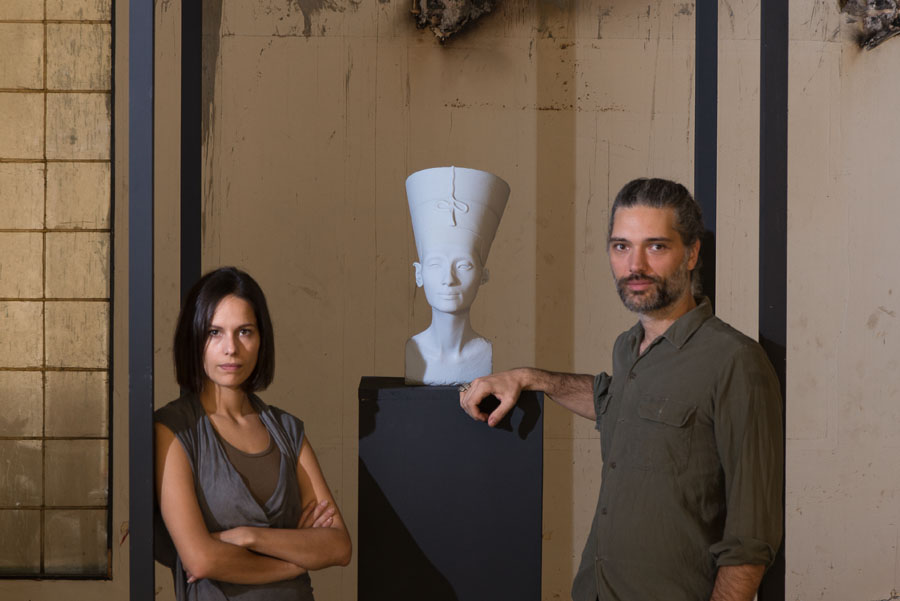
Artist Nora Al-Badri and Jan Nikolai Nelles with their "Other Nefertiti" now placed in the permanent collection of the American University of Cairo.
ART 100 YEARS LATER QUEEN NEFERTITI RETURNS TO EGYPT (As a perfect reproduction.) German-Iraqi artist Nora Al-Badri and German artist Jan Nikolai Nelles entered the Neues Museum in Berlin and clandestinely 3-D scanned the bust of Queen Nefertiti. No photos what-so-ever are allowed by the museum. Months later, they released the collected 3D data online, under public domain. Now anyone may download their information to create a precise 3D-printed polymer resin replica of the famous bust. A reproduction bust has been given to the American University of Cairo as a stand-in for the original 3,300-year-old work that was removed from Egypt shortly after its discovery in 1912, by German archaeologists in Amarna
This is a small animation made from the data of Nora Al Badri and Jan Nikolai Nelles. The digitized the bust of nefertiti in the Neues Museum Berlin and presented a printed copy in Cairo.They also did a Talk about this project at the 32C3 in Hamburg in 2015.
The project, called "The Other Nefertiti," is an artistic intervention to make cultural objects publicly available to all. For years, Germany and Egypt have disputed the rightful ownership of the extraordinary bust of Queen Nefertiti. Egyptian officials claim she left their country illegally and are demanding her return. With this controversy of ownership in mind, Al-Badri and Nelles took on this project.
• Remove all greens, wash and thoroughly dry the cauliflower then cut into 4 even sections.
• Grate your cauliflower using a box grater with the medium-size holes, or by using a food processor with an “S” shaped blade to create small pieces. The goal is cauliflower pieces the size of rice.
• Press any excess moisture from the cauliflower rice using a large paper towel or absorbent dish towel and squeeze to remove any remaining water. This helps from making your rice soggy.
• Sauté cauliflower rice using 1 Tbsp of olive oil in a large skillet over medium heat. Use a lid to cover and steam it, to make the rice even more tender. Cook for 5-8 minutes, stirring occasionally, then season to taste with salt and pepper.
Colossal statues became much more common during ancient Egypt's Middle Kingdom.
Notice the realism of this ear detail.
Throughout the history of the world, invading forces and political/ruling/dictatorial leaders of later years have had former rulers and their tombs, plus their temples of worship destroyed. All periods of ancient Egypt suffered this fate. Above, one can almost make out the unadulterated face of Pharaoh Amenemhat III (1859-1813 BC) in this profile photograph.
ART
Ancient Egypt
The Middle Kingdom
Representations of
Pharaohs, Men
& their Tributes
from a recent exhibition at the Metropolitan
Museum of Art
During the Middle Kingdom of Ancient Egypt (mid-Dynasty 11–Dynasty 13, around 2030–1650 B.C.), artistic, cultural, religious, and political traditions first conceived and instituted during the Old Kingdom were revived and re-imagined. Nebhepetre Mentuhotep II—the first pharaoh of the Middle Kingdom—was followed by a great cultural flowering that lasted nearly four hundred years.
This exhibition at the Metropolitan Museum of Art in NYC opened with a forceful, monumental statue of King Mentuhotep II, (first ruler of the Middle Kingdom) carved in an intentionally older style that suggests a link to the Old Kingdom (ca. 3300 B.C.). Early Middle Kingdom pharaohs are often depicted with youthful faces and confident expressions. In contrast, the evocative, fleshy faces and deep-set, hooded eyes of later New Kingdom pharaohs show startling images of maturity and humanity.
A tribute meal was always presented in a floating vertical manner above the the table, to show all of the items included.
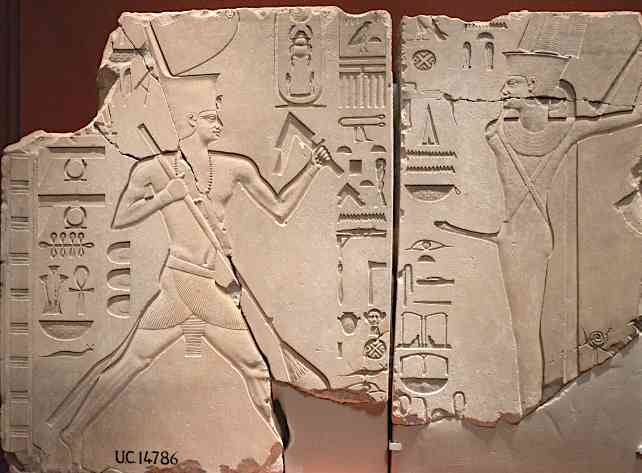
Pharaoh Senwosret I running toward the Egyptian God Min. Running rituals were generally connected with the Sed festival, a renewal rite the king ideally celebrated after thirty years on the throne.
This crown is actually two crowns, that of Upper Egypt is the bowling pin shape, the crown of Lower Egypt forms the base and rises in the back.
The uraeus, is a stylized cobra seen on a pharaoh’s crown, and the flail are standard symbols attributed to pharaohs. These visuals were often incorporated onto non-royal male sculptures during the Middle Kingdom.
The construction of pyramid complexes resumed during the Middle Kingdom, after a lapse. The innovation found in these complexes is exemplified by that of Senwosret III (around 1878-1840 B.C.) at Dahshur. This detailed 1-to-150 scale model shows the original form of the complex.
The pyramid of Senwosret III was about 210 feet high with an inclination of 50 degrees. Its base measured 345' x 345'. The core was built of mud bricks, rather than stone and encased with a 14 foot thick layer of white limestone blocks. A pattern of projections and recesses surrounded its base.
Although the queen was buried inside the large pyramid, several royal women had small pyramids inside the walls of the complex.
During the Middle Kingdom, members of all levels of Egyptian society commissioned a wider variety of works of art and constructed commemorative chapels at significant holy sites; statues of squatting figures rendered in a cubic, block-like form originate during this period.
Egypt during the Middle Kingdom was unified under one government. The main military concern for the nation was to keep enemies out. The arid plains they wanted to get rid of and deserts surrounding Egypt were inhabited by nomadic tribes who occasionally tried to raid or settle in the fertile Nile river valley. The Egyptians built fortresses and outposts along the borders east and west of the Nile Delta, in the Eastern Desert, and in Nubia to the south. Small garrisons could prevent minor incursions, but if a large force was detected a message was sent for the main army corps. Most Egyptian cities lacked city walls and other defenses. They enfeebled their enemies by using small projectile weapons, like bows and arrows. They also had chariots which they used to charge at the enemy.
Listen to the Met Museum's audio tour of this exhibition at the link below.
(Source: All photos were taken by ARTSnFOOD staff, with permission at The Metropolitan Museum of Art. Text based on information furnished by the Met. Museum. This exhibition was the first comprehensive presentation of Middle Kingdom art and culture at The Met, featuring many objects never before been shown in the United States.)
FOOD
PERSONAL TRAINER FOOD
Having trouble losing weight? It's not YOU, it's the FOOD.
"PERSONAL TRAINER FOOD" is a company dedicated to providing microwave ready foods to help clients start eating healthier meals, using their portion and calorie controlled plan. Their slogan is "Eat the right food and get the right results."
The Personal Trainer Food CEO and Founder says:
"Other companies talk about their food, it's what we are all trying to sell. No one talks about the whole program or the re-order rate.
We have the highest re-order rate ever in the diet food industry. Why? Because of taste, results and value. Bluntly put, our food is great, our program works, it's simple and affordable.
To prove our point, we asked a local fire station to taste test our food and to provide honest feedback."