Monday, June 1, 2015

Frida Kahlo at the New York Botanical Gardens + Mexican 7 Layer Dip For Office Parties


Portrait of Frida Kahlo, 1926 (detail)
ART
Frida Kahlo 
at the New York 
Botanical Gardens

This exhibition, at the New York Botanical Gardens, is the first solo presentation of artist Frida Kahlo’s work in New York City in more than 10 years, "FRIDA KAHLO: Art, Garden, Life", focuses on the artist’s engagement with nature in her native country of Mexico, as seen in her garden and decoration of her home, as well as her complex use of plant imagery in her painting. On view from May 16 through November 1, 2015, The New York Botanical Garden’s exhibition is the first to focus exclusively on Kahlo’s intense interest in the botanical world.

Frida Kahlo, Self-Portrait with Thorn Necklace and Hummingbird, 1940. 
Harry Ransom Center, The University of Texas at Austin.
© 2014 Banco de México Diego Rivera
Frida Kahlo Museums Trust, Mexico, D.F. 
Frida Kahlo (1907–54), revered as one of the most significant artists of the 20th century, has risen to prominence over the past three decades as an international symbol of Mexican and feminist identity. Important aspects of her life’s story, including her tumultuous relationship with her husband, muralist Diego Rivera (1886–1957), and her struggle with injury and illness, are well known and have been documented in countless biographies, exhibitions, fictional accounts, and analyses of her art. "FRIDA KAHLO: Art, Garden, Life" will add to this legacy by showcasing the artist’s love of Mexican plants and nature.


Frida at home, painting.
Notice the still-life with watermelon directly to her left.

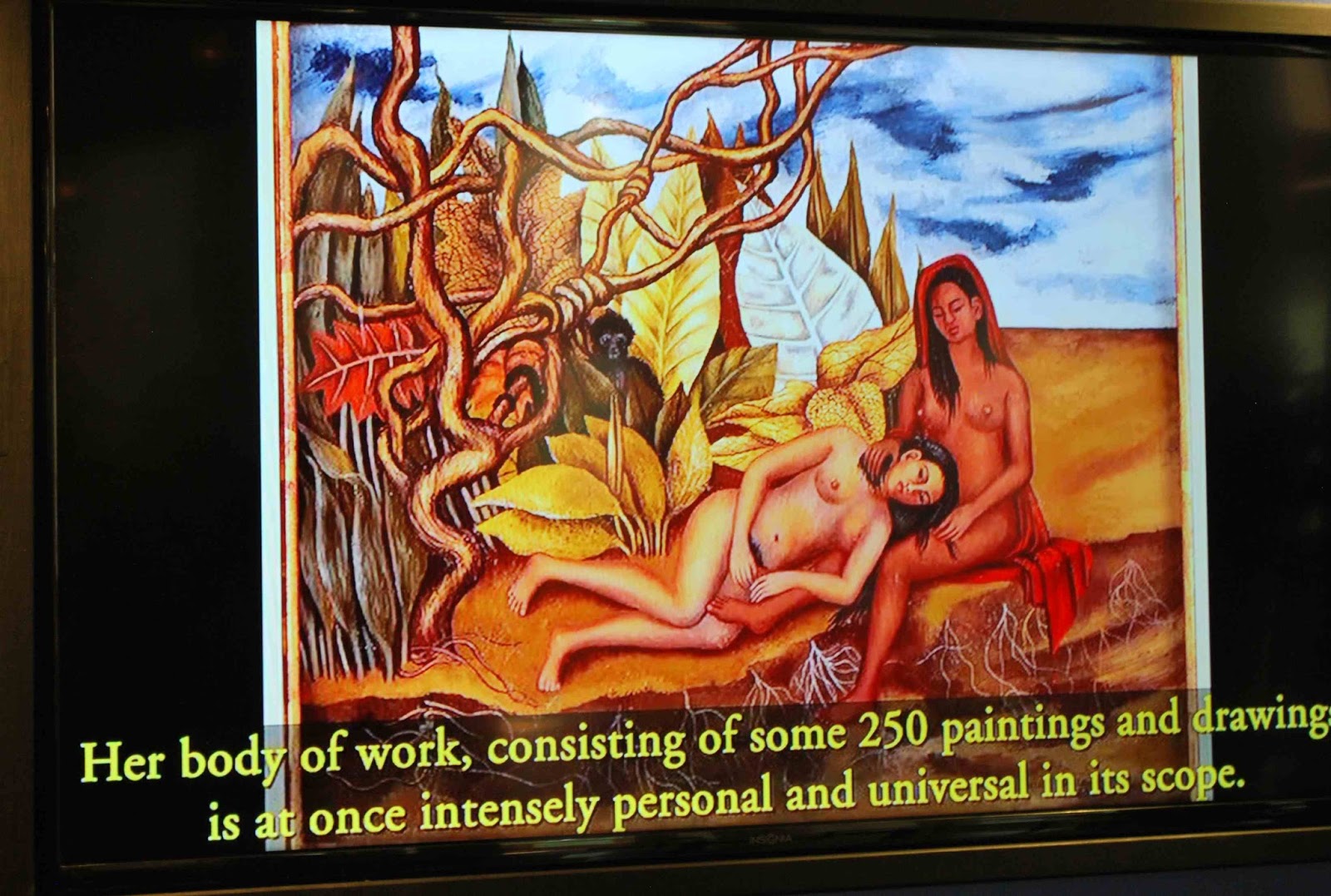
Of Kahlo’s approximately 250 works, 55 are self-portraits, and many more are portraits of friends and colleagues, including art patrons. Many of these portraits incorporate plants, animals, and other living things. In her still-life paintings, Kahlo depicts a variety of fruit and flowers, including many native to Mexico, alongside animals, Mexican folk art, and pre-Hispanic objects. Kahlo’s inclusion of plants and nature in her work spans her entire career but her most intensive dedication to the still-life genre dates to the 1940s and 1950s, particularly as her health declined and she was increasingly confined to her home and garden, which underwent its most significant period of development during the 1930s and 1940s.
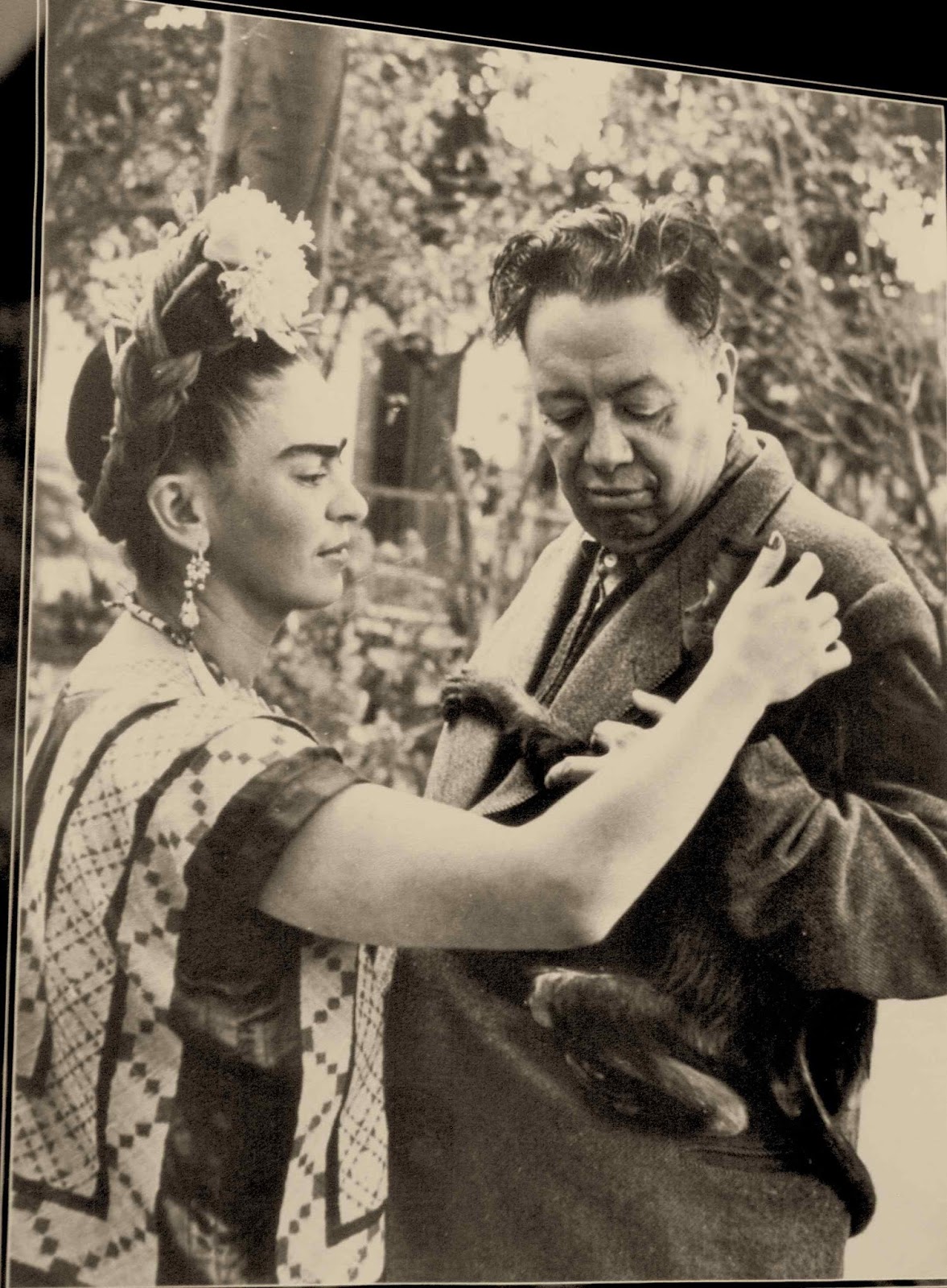

Frida with her husband, and famous artist/muralist, Diego Rivera.


Poster at the exhibition.

Frida Kahlo  c.1926
Photograph taken by her father Guillermo Kahlo.


Frida Kahlo overlooking her sculpture garden.


The official advertising poster: 
"FRIDA KAHLO: Art • Garden • Life".

Portrait of Luther Burbank, 1931. 
Museo Dolores Olmedo, Xochimilco, Mexico 
© 2015 Banco de México Diego Rivera 
Frida Kahlo Museums Trust, Mexico, D.F 

Poster at the exhibition.

Gisèle Freund's photo of Frida in her garden at Casa Azul, c.1951    


Humberto Spindola's Kahlo installation
currently at the NYBG
based on "The Two Fridas" painting.
Humberto Spindola's original "human display" of "The Two Fridas" 
performance/installation artwork
shown in 2009 at Museo Frida Kahlo in Mexico City.

Detail of The Two Fridas installation by Humberto Spindola.

Detail of "The Two Fridas" installation
by Humberto Spindola.
Humberto Spindola's "The Two Fridas" installation at NYBG.


A video presentation, at the NYBG exhibition, fills-in many details.
Frida's mid-career surrealistic style.


Frida's life was dramatically changed by a bus accident.
On September 17, 1925, Kahlo was riding in a bus that collided with a trolley car. She suffered serious injuries as a result of the accident, including a broken spinal column, a broken collarbone, broken ribs, a broken pelvis, eleven fractures in her right leg, a crushed and dislocated right foot, and a dislocated shoulder. Also, an iron handrail pierced her abdomen and her uterus, compromising her reproductive capacity.
A Frida self-portrait after her injury.
The accident left her in a great deal of pain, and she spent three months recovering in a full body cast. Although she recovered from her injuries and eventually regained her ability to walk, she had relapses of extreme pain for the remainder of her life. The pain was intense and often left her confined to a hospital or bedridden for months at a time. She had as many as 35 operations as a result of the accident, mainly on her back, her right leg, and her right foot. The medical complications and permanent damage also prevented Kahlo from having a child; though she conceived three times, all of her pregnancies had to be terminated.


Kahlo and Rivera befriended Leon Trotsky during the late 1930s, after he fled Norway to Mexico to receive political asylum from the Soviet Union, during Joseph Stalin's leadership. In 1937, Trotsky lived initially with Rivera and then at Kahlo's home where he and Kahlo had an affair.


After her accident, Kahlo abandoned the study of medicine and began to paint, to occupy herself during her three-month immobilization. Self-portraits were a dominant motif then. Kahlo once said, "I paint myself because I am so often alone and because I am the subject I know best." Her mother had a special easel made so she could paint in bed, and her father lent her his box of oil paints and some brushes. 


The face is intended to be Diego Reviera. In her surrealist style. 
A transition from her mid-career to late style.

A Frida Kahlo still life in her mid-career style

A Frida Kahlo still life in her mid-career style

A Frida Kahlo still life in her late-career style


Frida Kahlo's Casa Azul "Blue House".

Diego positioning Frita's face for the camera.

The Frida Kahlo exhibition continued in the conservatory of The Gardens where her garden at Casa Azul was recreated.
(The image above is of one of the many interesting tree composition at NYBG, but is not a part of the Kahlo exhibition.)
NYBG Haupt Conservatory
The exhibition included several working drawings, which were very interesting to view next to the finished paintings, and there were several Kahlo/Rivera "snapshots" depicting Casa Azul, their life and friends and her gardens.


Frida Kahlo in 1932,
photograph by her father, Guillermo Kahlo


A video discussion about the painting: 
"Self-portrait with Thorn Necklace".

For Botanical Garden Visitor Information: call the gardens at 718.817.8700 or on the web at www.nybg.org. The New York Botanical Garden is located at 2900 Southern Boulevard, Bronx, New York 10458 
(Scource: All photos were taken with permission or supplied by NYBG Press department. Text information was obtained from the exhibition, wikipedia and from the NYBG Press department.)


FOOD
Ann's Seven Layer Dip

This dish is great for office parties, the re-fried beans are layered with guacamole, seasoned sour cream, veggies and cheese! It's perfect as a dip for tortilla chips!

INGREDIENTS:
2 avocados - peeled, pitted and diced
1 1/2 tablespoons fresh lime juice
1/4 cup chopped fresh cilantro
1/4 cup salsa
garlic salt to taste
ground black pepper to taste
1 (8 ounce) container sour cream
1 (1 ounce) package taco seasoning mix
4 roma (plum) tomatoes, diced
1 bunch green onions, finely chopped
1 (16 ounce) can re-fried beans
2 cups shredded Mexican-style cheese
blend
1 (2.25 ounce) can black olives - drained
and finely chopped

DIRECTIONS:
1. In a medium bowl, mash the avocados. Mix in lime juice, cilantro, salsa, garlic salt and pepper.
2. In a small bowl, blend the sour cream and taco seasoning.
3. In a 9x13 inch dish or on a large serving platter, spread the re-fried beans. Top with sour cream mixture. Spread on guacamole. Top with tomatoes, green onions, Mexican-style cheese blend and black olives.

Until later,
Jack

ARTSnFOOD, is an online publication dedicated to "The Pursuit of Happiness through the Arts and Food." ™ All rights reserved. Concept, Original Art, Text & Photographs are © Copyright 2015 Jack A. Atkinson under all International intellectual property and copyright laws. Any gallery, event, museum, fair or festival photographs were taken with permission. Images © individual artists, fabricators, respective owners or assignees.

Wednesday, May 20, 2015

Costume Institute at Met Museum NYC Focuses on Chinese Influence in Fashion Through Time + Food: Cooking Potatoes

ART
The Met Museum:
An Exhibition on
Chinese Influence
in Fashion
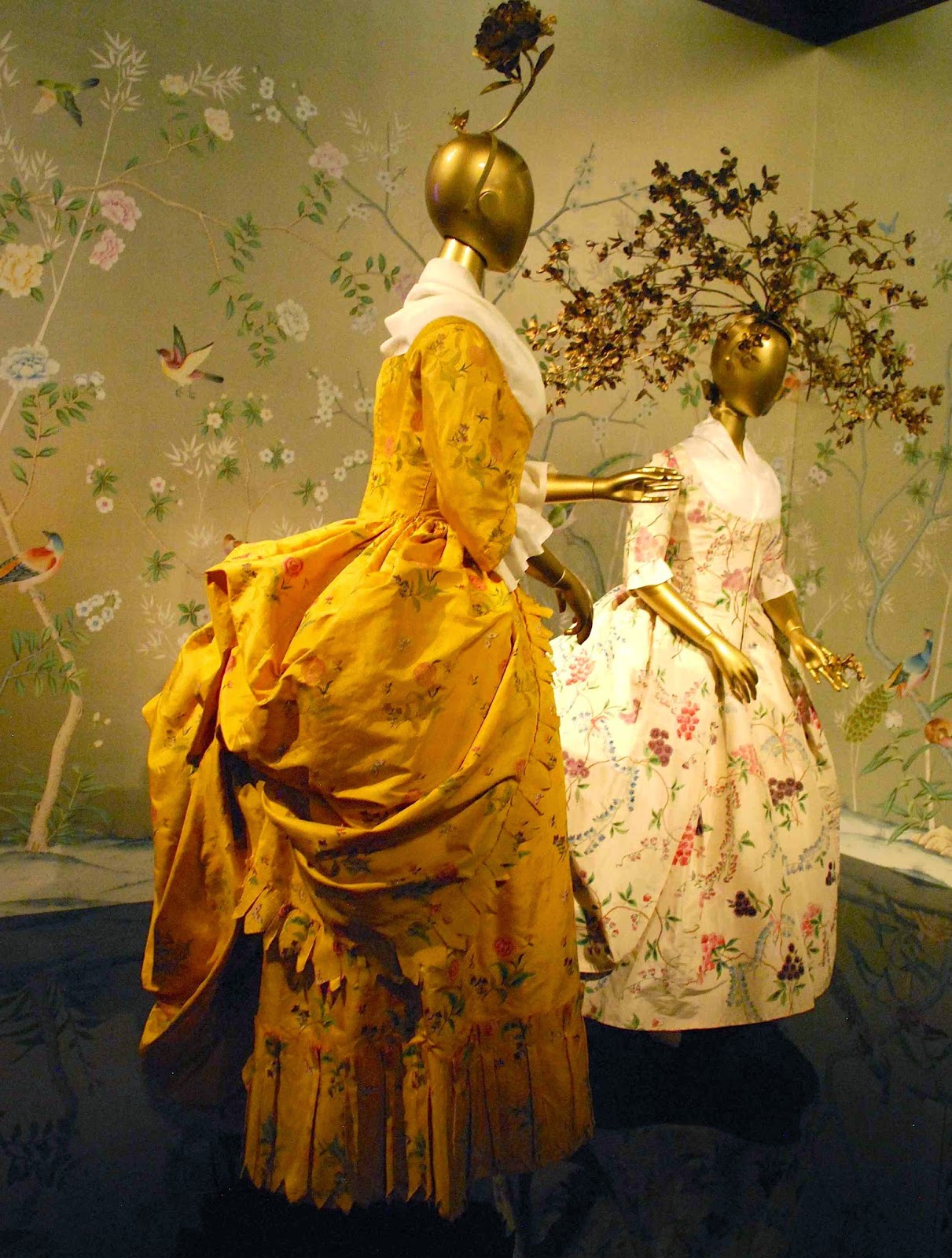
The Costume Institute’s spring 2015 exhibition, China: Through the Looking Glass, is on view at The Metropolitan Museum of Art through August 16, 2015. The Costume Institute and the Department of Asian Art, have juxtaposed high fashion with Chinese costumes, paintings, porcelains, and other art, including films, to reveal enchanting reflections of Chinese imagery.


“From the earliest period of European contact with China in the 16th century, the West has been enchanted with enigmatic objects and imagery from the East, providing inspiration for fashion designers from Paul Poiret to Yves Saint Laurent, whose fashions are infused at every turn with romance, nostalgia, and make-believe,” said Andrew Bolton, Curator in The Costume Institute. “Through the looking glass of fashion, designers conjoin disparate stylistic references into a fantastic pastiche of Chinese aesthetic and cultural traditions.”

China: Through the Looking Glass features more than 140 examples of haute couture and avant-garde ready-to-wear alongside masterpieces of Chinese art. Filmic representations of China are incorporated throughout to reveal how our visions of China are shaped by narratives that draw upon popular culture, and to recognize the importance of cinema as a medium through which we understand the richness of Chinese history.


BOOK:
China: Through the Looking Glass, by Andrew Bolton accompanies the exhibition. ($45 for the gold-stamped flexi-bound edition with 256 pages, 40 printed vellum leaves, and 231 color illustrations. A deluxe limited boxed edition of 500 numbered copies has a traditional Chinese string binding and a framable "Platon" photographic print. The limited edition is $250 and available only at the Museum.)


There is a video at the end of the article showing the Met Gala, RED CARPET extravaganza which opened the exhibition on May 4, 2015. Also find a link to another website showing the evening gowns the stars wore at the Red Carpet, Met Gala. 

Walk with us now, through the exhibition.

First a video overview of the "China: Through the Looking Glass" exhibition, with commentary from the Met's curator for the Costume Institute

(Captions were unavailable to ARTSnFOOD, but all of these fashions have Chinese influence and represent many periods of fashion and design.) 


The video below documents the Met Gala's Red Carpet at the "China: Through the Looking Glass" Exhibition Opening on May 4th, 2015.
 

(Source: All photos, above, were taken by ARTSnFOOD staff with permission and on location at the exhibition. Text information and videos: The Metropolitan Museum of Art Press Department.)


MORE RED CARPET
FASHION
PHOTOGRAPHS 
at other websites, links below:

FOOD
COOKING POTATOES
Baked:

How To Make a Perfect Baked Potato:

Got time? 
1. Preheat oven to 375 degrees F.
2. Start with organic russet potatoes of the large baking variety. Wash, scrub, and dry the potatoes.
3. Brush each potato skin with olive oil and sprinkle lightly with ground sea salt.
4. Poke holes on all sides with the point of a sharp knife or fork.
5. Bake at 375 degrees F for 75 minutes, turn up the heat to 400 
degrees for the final 15 minutes. (This can vary depending on the size of your baked potato and the altitude at which you live, so you will still need to test for doneness and find what cook time works best for you.)
Short on time?
1. Preheat oven to 450 degrees F.
2. Start with an organic russet potato of the large baking variety. Wash, scrub, and dry the potato. 
3. Poke holes on all sides with the point of a sharp knife or fork. Microwave the potatoes, up to 4 at a time, on full power for 4 minutes.
4. Turn potato over and microwave for 4 more minutes.
------
Optional, for crispier skin:
5. Brush the skin with olive oil mixed with disloved sea salt. 

6. Then, bake the microwaved potato in the 450 degree F preheated oven for 20 minutes.

Cooking Potatoes
for Potato Salad
  • Pick the Right Potato
  • Firm and creamy varieties stand up better to being tossed and dressed than soft and starchy ones, which can fall apart. Choose fingerlings, red bliss, new white potatoes, Yukon Gold or any of the small heirloom potatoes you see. Avoid russets.
  • Small Is Beautiful
    Choose potatoes that are all the same size so they cook at the same rate; the smaller the better. Ideally, the potatoes should be small enough that you need only halve or quarter them to yield a nice compact bite. So-called micro-potatoes are ideal.
  • Pour on the Salt
    Don’t be shy with the shaker. Boil potatoes in water as salty as the sea; this ensures even seasoning and maximum flavor.
  • Give Them Room
    Don’t crowd the potatoes in the pot; they need elbow room to cook evenly. Crowding also slows down the cooking.
  • Watch the Pot
    Start checking on the potatoes after 15 minutes for small ones, 20 minutes for medium-size spuds. And don’t overcook — you want them tender in the center but not mushy at the edges. Use the tip of a paring knife to test, not a fork, which can break up their flesh. When done, the potato should fall off the knife and back into the pot.

  • Cut ’Em While They’re Hot 
  • As soon as you can bear touching them, cut the potatoes into bite-size chunks or wedges while they are still hot (or at least warm). Hot potatoes drink up more dressing.
  • Learn the Ratio
    For every 2 pounds of potatoes, you’ll need 1/2 cup to 1 cup of dressing, depending on how saturated you like your salad. For a classic summertime dressing, spike 2/3 cup of mayonnaise with a tablespoon of mustard, a tablespoon or two of cider vinegar or lemon juice, and 3 tablespoons of minced red or white onion.
  • Add Stuff in Stages
    Toss with dressing while the potatoes are hot, but keep other vegetables and herbs separate until the last minute, lest they wilt in the heat.

  • Double Up on the Dressing
  • Potato salads always need more dressing than you think, so keep extra on hand to add at the last minute.
  • Taste It Again
  • Flavors have a way of settling down, so be sure to give the salad a taste just before serving, and adjust the seasoning by adding more dressing, salt, pepper and/or whatever acid (like lemon juice or vinegar) you used in the dressing.
(Source: Information for Baked Potatoes come from Wikipedia and various other online recipe sites. Information for Cooking Potatoes for Potato Salad was originally published at NYTimes.com website.)
Link below to potato salad recipes
Jack
ARTSnFOOD, is an online publication dedicated to "The Pursuit of Happiness through the Arts and Food." ™ All rights reserved. Concept, Original Art, Text & Photographs are © Copyright 2015 Jack A. Atkinson under all International intellectual property and copyright laws. Any gallery, event, museum, fair or festival photographs were taken with permission. Images © individual artists, fabricators, respective owners or assignees.