Metropolitan Museum of Art's "African Art, New York, and the Avant-Garde"
An Exhibition focused on the African art collected by New York's avant-garde following the landmark 1913 Armory Show of "Modern Art".
 |
Charles Sheeler
(1918 Photo of the African sculpture below)
African Negro Wood Sculpture
Portfolio of 20 photographs – gelatin silver print
H. x W.: 16 3/16 x 13 5/16 in.
James J. and Laura Ross, New York |
 |
Figure from a Reliquary Ensemble: Seated Figure
Created by an unidentified Fang artist, Ntumu group;
Equatorial Guinea or Gabon
19th century or early 20th century, before 1916
Wood, oil H.: 23 1/8 in
National Museum of African Art
Smithsonian Institution, Washington, D.C.
Gift of Eugene and Agnes E. Meyer Foundation
Photograph by Frank Khoury |
In the US, the early 20th century was a time when the appreciation of Africa's rich and diverse artistic heritage shifted dramatically from being considered European colonial trophies to becoming modernist icons of art.
 |
Mask - Côte d’Ivoire
19th – early 20th century (before 1914)
Wood H.: 9 7/16 in. (24 cm)
Musée Dapper, Paris (2825)
© Archives Musée Dapper – Photo Hughes Dubois |
 |
Constantin Brancusi
(Shows dramatic African Art influence in this work.)
Study for the sculpture “The First Step”
ca. 1913 Wax crayon on paper
H. x W.: 20 x 12 1/4 in.
The Metropolitan Museum of Art, Alfred Stieglitz Collection, 1949
© 2012 Artists Rights Society (ARS), New York / ADAGP, Paris |
 |
This work was a blow to safe institutional art, showing that African Art
had taught Picasso how to look at the human face and form differently.
Pablo Picasso's "Les Demoiselles d'Avignon"
1907 Oil on Canvas
Now in the collection of the Museum of Modern Art, NYC.
(Source: Image from Wikipedia. This artwork is not a part of the current Met exhibition.) |
This exhibition evokes the original context in which these African tribal artworks were viewed as fresh, alternative depictions of the human form. This changed the visual arts forever, as artists looked for new ways to portray the world around us - a concept which started with impressionism but embracing and emulating the tribal arts, from around the world, art previously overlooked in "Western Art History".
 |
Charles Sheeler - photographer
[John Quinn Album of African Art] 1919
Portfolio of 27 photographs – gelatin silver print
H. x W.: 16 3/16 x 13 5/16 in. (41.12 x 33.81 cm)
Museum of Fine Arts, Boston. Anonymous Lender
© The Lane Collection. Courtesy, Museum of Fine Arts, Boston |
36 wood sculptures from West and Central Africa are presented alongside the photographs, sculptures and paintings which they inspired - created by many of the leading artists of the modern art movement: Stieglitz, Picasso, Matisse, Brancusi, Picabia, etc.
 |
Francis Picabia
(French, Paris 1879-1953 Paris)
Negro Song I 1913
Watercolor and graphite on paperboard
H. x W.: 26 1/8 x 22 in. (66.4 x 55.9 cm)
The Metropolitan Museum of Art,
Alfred Stieglitz Collection, 1949
© 2012 Artists Rights Society (ARS), New York / ADAGP, Paris |
The exhibition unfolds chronologically and thematically in 4 Sections.
Section 1—1914: America Discovers African Art
 |
| The "Armory Show", held at the NYC 69th Regiment Armory - Lexington Ave at 25th St. - in 1913, was actually titled International Exhibition of Modern Art. The avante-garde exhibition changed the American art scene forever. |
1914 was a turning point for African art in America. After the dramatic modern art "Armory Show" of 1913, two New York galleries started exhibiting African sculpture for their collectors in 1914: the Robert J. Coady Gallery; and Alfred Stieglitz’s gallery simply named "291". Featured prominently in this section is Stieglitz’s exhibition dedicated entirely to African artifacts as works of art. Photographs of this early installation are displayed along with artworks exhibited in Stieglitz's show, some reunited in America for the first time since 1914.
 |
Alfred Stieglitz (American, 1864–1946)
Photograph based on the “Picasso-Braque” exhibition, gallery 291, New York
1915 Platinum print H. x. W.: 7 5/8 x 9 5/8 in. (19.4 x 24.4 cm)
The Metropolitan Museum of Art, Alfred Stieglitz Collection, 1949 (49.55.36)
© The Metropolitan Museum of Art |
 |
Sculptural Element from a Reliquary Ensemble
Similar to the one pictured in the photo above.
Created by an unidentified Kota artist; Gabon
19th – early 20th century (before 1926)
Wood, brass, copper
H. x W. x D.: 22 1/16 x 10 5/8 x 1 3/16 in. (56 x 27 x 3 cm)
Art and Artifacts Division of the Schomburg Collections, New York Public Library
©Art and Artifacts Division, Schomburg Center for Research in Black Culture, The New York Public Library |
 |
Ogooué—Congo Half-tone relief print
Published in the periodical 291 (February 1916, no. 12)
H. x W.: 20 1/8 x 13 1/2 in. (51.1 x 34.3 cm)
The Metropolitan Museum of Art, Alfred Stieglitz Collection
© The Metropolitan Museum of Art |
 |
Element from a Reliquary Ensemble
Created by an unidentified Kota (Ndassa group) artist; Republic of Congo
19th – early 20th century (before 1914)
Wood, copper, brass and pigments H:. 23.62 in
Musée Dapper, Paris © Archives Musée Dapper – Photo Mario Carrieri |
 |
Henri Matisse - Sculpture
(French, Le Cateau-Cambrésis 1869 – 1954 Nice)
Female Torso
Date: 1906; cast ca. 1908 Bronze, 2/10
H. x W. x D.: 9 1/8 x 4 x 3 in.
The Metropolitan Museum of Art, Alfred Stieglitz Collection, 1949
© 2012 Succession H. Matisse /
Artists Rights Society (ARS), New York |
 |
Alfred Stieglitz - photograph
Georgia O'Keeffe with Matisse Sculpture 1921
Palladium print H. x W.: 9 5/8 x 7 9/16 in. (24.4 x 19.2 cm)
The Metropolitan Museum of Art, Gift of Georgia O'Keeffe,
through the generosity of The Georgia O'Keeffe Foundation
and Jennifer and Joseph Duke, 1997
© The Metropolitan Museum of Art |
 |
Spoon (left)
Created by an unidentified Baule or We or Dan artist, Côte d'Ivoire
19th – early 20th century (before 1914)
Wood H. x W. x D.: 7 3/8 x 2 1/16 x 1 7/8 in.
Collection of Juan and Anna Marie Hamilton |
 |
Alfred Stieglitz - photographer
His Wife: Georgia O’Keeffe Holding the African spoon pictured above.
ca. 1918-19
Gelatin silver print
H. x W.: 4 7/16 x 3 1/2 in. (11.27 x 8.89 cm)
Collection John and Lisa Pritzker |
Section 2—1915-19: Acquiring a Taste for African Art
New York City progressively positioned itself as a central marketplace for African art. From 1915-19 American dealers began promoting African objects as art to collectors. Among the works on view, a rich ensemble of photographs by American artist Charles Sheeler vividly records New York’s encounter with African art.
 |
The Soil vol. 1, no. 5
July 1917 Journal H.: 10 ¼ in (26 cm)
The Metropolitan Museum of Art, Thomas J. Watson Library (Rogers Fund, 1917)
Image generously made available through Jstor, provided by The Metropolitan Museum of Art, Thomas J. Watson Library (Rogers Fund, 1917) |
 |
Sculptural Element from a Reliquary Ensemble: Head (Shown in printed photo above.)
Created by an unidentified Fang artist, from the Betsi group; Gabon
19th century (before 1914) Wood H.: 9 1/8 in.
Curtis Galleries, Inc. |
 |
Charles Sheeler (American, Philadelphia, Pennsylvania 1883-1965 Dobbs Ferry, New York)
Interior of Arensberg’s Apartment, 33 West Sixty-Seventh Street, New York
1919 Casein silver print H. x W.: 14 x 18 in
Philadelphia Museum of Fine Art,
The Louise and Walter Arensberg Collection, 1950
© Philadelphia Museum of Fine Art |
 |
Sculptural Element from a Reliquary Ensemble: Head
Unidentified Fang artist, from the Betsi Group; Gabon,
Lower Ogooué River Valley
19th century (before 1913)
Wood, brass, resin, oil H.: 10 5/8 in.
Philadelphia Museum of Fine Art,
The Louise and Walter Arensberg Collection, 1950
© Philadelphia Museum of Fine Art |
 |
Figure from a Reliquary Ensemble: Seated Male Holding Horn
Unidentified Fang artist, from the Ngumba group;
southern Cameroon, Lokoundje Valley
19th century (before 1913)
Wood H.: 23 1/8 in.
Philadelphia Museum of Fine Art,
The Louise and Walter Arensberg Collection, 1950
© Philadelphia Museum of Fine Art |
 |
Clara E. Sipprell (American (born in Canada),
Tilsonburg, Ontario 1885 – 1975 Manchester, Vermont)
Portrait of Max Weber
ca. 1916 Gelatin silver print, in original exhibition mat
H. x W.: 3 7/8 x 9 3/8 in.
Museum of Fine Arts, Boston. Museum
purchase with funds donated by
Hope and Charles Hare and Kyle and Thomas Einhorn
Photograph © 2012 Museum of Fine Arts, Boston |
Section 3—1919-23: A Move Toward Institutions
During the early 1920s, American institutions began opening their doors to African art. Collections from the University of Pennsylvania Museum and the Whitney Studio are on view and include three photographs by Charles Sheeler capturing the 1923 exhibition entitled Recent Paintings by Pablo Picasso and Negro Sculpture at the Whitney Studio Club. Exhibited nearby is a 19th-century Fang reliquary head from Gabon, which is a subject appearing in two of the Sheeler’s photographs.
 |
Charles Sheeler
Three Installation views of Whitney Studio Club
exhibition “Recent Paintings by Pablo Picasso and Negro Sculpture”
1923 Gelatin silver print H. x W.: 7 3/8 x 9 3/16 in.
Whitney Museum of American Art, New York, Gift of Gertrude Vanderbilt Whitney
Photograph by Robert Gerhardt |
 |
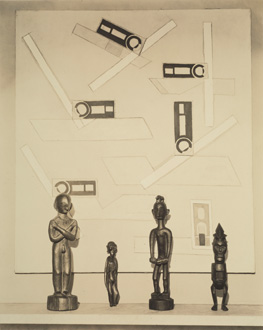
Charles Sheeler
Untitled [Indonesian, Easter Island, and Africa sculptures
in front of an unidentified painting by Morton Schamberg (?)]
ca. 1917
Gelatin silver print
H. x W.: 9 7/15 x 4 5/8 in.
Museum of Fine Arts, Boston. Anonymous Lender
© The Lane Collection, Photograph courtesy Museum of Fine Arts, Boston |
Section 4—The Blondiau-Theatre Arts Collection and the Harlem Renaissance
The Harlem Renaissance was a cultural movement characterized by the flowering of African-American literature, theater, music, and art in the 1920s. In Harlem, African art resonated with the desire for African American New Yorkers to connect with their distant past. Harlem Renaissance philosopher, Alain LeRoy Locke (1885–1954), obtained a large collection of African art from what was then known as the Belgian Congo. Selected works from his collection—now dispersed—are displayed alongside the works by the African-American artists they inspired. Negro Masks, a painting by Malvin Gray Johnson (American, 1896-1934), will be reunited for the first time with the masks from Nigeria and the Democratic Republic of the Congo it depicts.
|
|
African masks from Nigeria and
Democratic Republic of the Congo
referenced in the painting below.
|
 |
Malvin Gray Johnson - Painter
(American, Greensborough, North Carolina 1896 – 1934 New York City)
Negro Masks 1932
Oil on canvas H. x W.: 20 x 18 in. (50.8 x 45.72 cm)
Collection of Hampton University Museum, Hampton, VA |
 |
Pablo Picasso
(Spanish, Malaga 1881-1973 Mougins, France)
Seated Man Reading a Newspaper
1912 Ink on paper H. x W.: 12 1/8 x 7 3/4 in.
The Metropolitan Museum of Art, Alfred Stieglitz Collection, 1949
© 2012 Estate of Pablo Picasso / Artists Rights Society (ARS), New York |
In addition to 11 works from the Metropolitan Museum’s own holdings, the exhibition includes 51 loans from private and institutional collections including the University of Pennsylvania Museum, Philadelphia; Museum of Fine Arts, Boston; Field Museum of Natural History, Chicago; Musée Dapper, Paris; Art and Artifacts Division of the Schomburg Center for Research in Black Culture, New York; and the National Museum of African Art, Washington, D.C.(Sources: Visit to the exhibition and Met. Museum Press Dept.)
There is no FOOD section in this issue.
Until later,
Jack
Postscript:
More sculptures
from the Met exhibition
 |
Female Mboko Bowl Bearer
Created by a Luba artist from the Middle Lukuga Workshop
(possibly active between 1810 and 1840); Lukuga River region,
Democratic Republic of the Congo 19th century
Wood, iron H: 12 5/8 in.
The University of Pennsylvania Museum, Philadelphia
Courtesy of the Penn Museum, image # 161428 |
 |
Figure: Female
Created by an unidentified Beembe artist; Republic of the Congo
19th – early 20th century (before 1913)
Wood with glass, white pigment, and animal claw
H. x W. x D.: 23 11/16 x 5 1/2 x 4 1/2 in.
The University of Pennsylvania Museum, Philadelphia
Courtesy of the Penn Museum, image # 175174 |
 |
Figure from a Reliquary Ensemble: Seated Male Holding Cup
Created by an unidentified Fang artist; Gabon
19th – early 20th century (before 1914)
Wood, brass or copper
H. x W.: 20 1/16 x 22 13/16 in.
Collection Pierre Amrouche |
 |
Figure: Male
Created by an unidentified Kusu or northern Luba artist; Kasongo Region,
between the Lukuga and Luika Rivers, Democratic Republic of the Congo
19th – early 20th century (before 1916)
Wood, paint
H. x W.: 19 3/4 x 8 x 8 1/2 in.
The Field Museum of Natural History, Chicago
© The Field Museum A109423c. Photographer Diane Alexander White |
 |
Maiden Mask (agbogho mmuo)
Created by an unidentified Igbo artist; Nigeria
19th – early 20th century (before 1922)
Wood, pigment
H.: 17 ½ in.
The University of Pennsylvania Museum, Philadelphia
Courtesy of the Penn Museum, image # 150519 |
 |
Mask for Men’s Association (probably Bo nun amuin)
Created by an unidentified Baule or Lagoon artist; Côte d’Ivoire
19th – early 20th century (before 1912)
Wood, paint and tacks L.: 27 5/8 in.
The University of Pennsylvania Museum, Philadelphia
Courtesy of the Penn Museum, image # 150800 |
 |
Female Face Mask (ngady mwaash)
Created by an unidentified Kuba artist; Democratic Republic of the Congo
19th – early 20th century (before 1926)
Wood, pigment, raffia textile, cowrie shells
H. x W.: 13 x 10 ¼ in.
Art and Artifacts Division of the Schomburg Collections, New York Public Library
©Art and Artifacts Division, Schomburg Center for Research in Black Culture,
The New York Public Library |
 |
Mask for a forest spirit
Created by an unidentified Bete or We artist, Côte d’Ivoire
19th – early 20th century (before 1914)
Wood H. x. W. x D.: 14 3/4 x 7 1/4 x 6 3/4 in.
Collection of Juan and Anna Marie Hamilton |
 |
Mask (probably Kpeliye’e)
Created by an unidentified Senufo artist; Côte d’Ivoire, possibly Korhogo region
19th – early 20th century (before 1913)
Wood H. x W. x D.: 13 5/16 x 7 5/16 x 3 9/16 in.
The University of Pennsylvania Museum, Philadelphia
Courtesy of the Penn Museum, image # 175175 |
 |
Mask (Kifwebe)
Created by an unidentified Songye artist; Democratic Republic of the Congo
19th – early 20th century (before 1919)
Wood, white pigment H. x W.:14 3/4 x 9 1/2 in.
The University of Pennsylvania Museum, Philadelphia
Courtesy of the Penn Museum, image # 150520 |
 |
Portrait Mask
Created by an unidentified Baule or Guro artist, Côte d’Ivoire
19th – early 20th century (before 1914)
Wood
H. x W. x D.: 16 3/8 x 6 ½ x 4 ½ in.
Collection of Juan and Anna Marie Hamilton |
 |
Prestige Stool (Kipona)
Created by a Luba artist, identified as the Master of the Warua or the Master of the Kunda
(possibly active between 1780 and 1810); Luvua Valley Region,
Democratic Republic of the Congo
Late 18th-early 19th century
Wood, glass beads H. x W. x D.: 16 11/16 x 9 1/8 x 8 7/16 in.
The University of Pennsylvania Museum, Philadelphia
Courtesy of the Penn Museum, image # 150529 |
 |
Seated Female Figure with Child (pfemba)
Created by an unidentified Kongo artist, Yombe group;
Democratic Republic of the Congo, Republic of the Congo,
or Cabinda Province, Angola
19th – early 20th century (before 1926)
Wood, brass tacks, pigment H. x W. x D.: 9 3/4 x 3 3/8 x 3 in.
The National Museum of African Art,
Smithsonian Institution, Washington D.C., Museum Purchase
Photograph by Frank Khoury |
 |
Sculptural Element from a Reliquary Ensemble: Head
Created by an unidentified Fang artist; Gabon
19th-early 20th century (before 1923)
Wood H.: 8 ¼ in. (21 cm)
Troyes, Musée d’art moderne, collections nationales
Pierre et Denise Lévy, France
© Carole Bell |
 |
Seated Female Figure
Created by an unidentified Ijo artist; Nigeria
19th – early 20th century (before 1913)
Wood H.: 33 1/2 in.
University of Pennsylvania Museum
Courtesy of the Penn Museum, image # 161410 |
(Sources: Visit to the exhibition and Met. Museum Press Dept.)
ARTSnFOOD, is an online publication dedicated to "The Pursuit of Happiness, the Arts and Food." ™ All rights reserved. Concept, Original Art, Text & Photographs are © Copyright 2013 Jack A. Atkinson under all International intellectual property and copyright laws. All gallery, museum, fair or festival photographs were taken with permission. Images © individual artists, fabricators, respective owners or assignees