 | |
|
ART:
"WADE GUYTON OS"
The Whitney Museum of American Art Gives Digital Output Art a Spotlight!
Ends January, 2013

Wade Guyton worked at the minimal museum mecca, DIA Chelsea, as a guard ten years ago. We would be talking about him as a good post-minimalist painter and sculptor who arrived on the New York Art Scene 30 years too late to be an important part of the original Minimalist Art Movement - EXCEPT for the fact that his medium is "Digital Output!"
 |
| Guyton's works are deployed here in a dramatic "architectural" installation including the largest canvas (fifty feet wide) ever to be hung at the Whitney Museum, plus other multi-panel paintings stretching more than twenty feet high and digital "drawings" which fill dozens of vitrines. |
OS (operating system) “The title links Guyton’s art to the tools he uses and the systems by which he works,” explains Scott Rothkopf, the young curator and champion of this artist, who staged the show at The Whitney. Guyton's “tools” are scanners and a massive ink jet printer and his “process” includes running pieces of folded prepared linen through his printer.

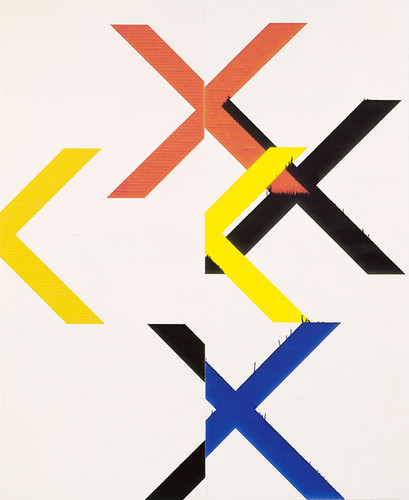
The works on view don’t come across at first blush as digital art, but make the museum visitor feel as if they have stumbled into an exhibition of minimalist paintings and sculptures made up of art like: Ellsworth Kelly's colored stripes, Donald Judd's repeating boxes, Agnes Martin's grid paintings, Robert Mangold's "Xs", Ad Reinhardt's "black" paintings, Robert Ryman's "white" paintings, etc.
But this exhibition also has something in common with Pollack and Warhol, too - "Nothing less than a paradigm shift in what the art establishment accepts as and what they are willing to define as 'painting'. This Whitney show officially re-defines painting to include digital output artworks!" A giant leap for mankind! One 50-foot-wide digital output stretches across the entire north wall of one floor of the museum's Marcel Breuer building. It is a work of repeating green and red stripes reproduced from a design found in a book functioning as colorful end-papers, which the artist scanned into his computer, then linked into a long repeating file.
Guyton creates his paintings by feeding linen through his printer and predictably the machine frequently makes mistakes: printer heads get clogged; the fabric jams; the coating cracks; ink drips; and the wet ink gets smeared across the surface. Normally production types would have thrown these outputs away, thinking of them as a "crappy printing job", but Guyton has embraced these mistakes as being a new version of "artistic drips," like those in an abstract expressionist paintings.
 |
| (Minimalist & Color Field painters with influence on this show - Left to Right) Paintings by: Barnett Newman, (Voice of Fire, detail, 1967, oil), Robert Mangold (X within an X, 1981, mixed media), Ellsworth Kelly (The Meschers, 1951, oil ). |
Guyton creates his paintings by feeding linen through his printer and predictably the machine frequently makes mistakes: printer heads get clogged; the fabric jams; the coating cracks; ink drips; and the wet ink gets smeared across the surface. Normally production types would have thrown these outputs away, thinking of them as a "crappy printing job", but Guyton has embraced these mistakes as being a new version of "artistic drips," like those in an abstract expressionist paintings.

When Guyton worked as a guard at DIA’s NYC Chelsea space, he was trying to make minimalist sculptures in his small apartment at night. With little space leftover, he started making "artworks" by printing solid black type or black bars over printed photos ripped from books. Now, only a decade later, Guyton is enjoying a mid-career survey at a one of America's major art museums and DIA Chelsea, is long gone.
On the gallery floor, glass vitrines showcase his "drawings" illustrating how Guyton’s process emerged, tearing pages from old books on architecture, and using Microsoft Word to print on top of these ready-made images.

"I was never a doodler. I had never felt a drive to draw." Instead, he has allowed the software to draw for him. "The Epson printer sitting on my desk could make these marks much more efficiently." He was intrigued by two particular capital letters the "U" and the "X" which are still the subject of much of his work.

"X" has become a unique trademark for Guyton, suggesting a signature, a cancellation, a reference to pornography and to our current culture. ie: The X-Files; Xbox; and X-Men; etc. His "U" manifests itself as a sculpture and sometimes in paintings is lapped from below by flames. Rothkopf explains, "Simultaneously beckoning and menacing, these fiery paintings record Guyton’s process as he brings an image from the screen to the canvas."

In the mid 2000s, he began working in a larger scale, using linen rather than his paper book pages. His newer paintings still maintain his relationship with scanners, printers, software, and how we view the newly reconfigured output/image/photograph/painting.

 |
| An early Guyton flame "drawing". |
Warhol is evident in Guyton's with his taking of found commercial imagery and his use of commercial typography, but by involving the computer and printer as his studio assistant, Guyton has made his "Factory" a completely hands off art-making process. He has said he wants to remove "the hand" from his art.
 |
| Interestingly, most of the time Guyton hangs his canvases so that the drips on the canvas are heading up. |
 |
| Artist Wade Guyton at The Whitney. |


The misuse of the technology and the mistakes this process creates, he calls interesting "accidents" or mechanical versions of "subtle painterly gestures made through mechanical failure."

Curator Scott Rothkopf says these accidents relate to our daily lives, which are now punctuated by computer error, misprinted outputs and blurred images on our phones and computer screens.

The show, comprising more than eighty works dating from 1999 to the present, is Guyton’s first mid-career survey. The exhibition features a dramatic, non-chronological layout in which staggered rows of parallel walls confront the viewer like the layered or stacked windows on a monitor. The exhibition includes paintings, drawings, photography, and sculpture. This exhibition illuminates Guyton's digital methods and showcases his minimalistic artworks and concepts. The "OS" in the show's title represents the common acronym for “operating system” meaning Guyton’s art and this exhibition is important because of the computer technologies used to create the visual images.
To summarize: During the past decade, Wade Guyton (b. 1972) is an artist who uses technology to make his digital paintings and digital drawings. His "drawings" are made by printing letters and solid shapes over found book pages, using software to make shapes and letter forms; his "paintings" are executed by running sheets of primed canvas and linen through a large-format Epson printer which is printing a letter form or scanned design he has collaged together within his computer. Most canvas works in this exhibition are credited as Ultra Chrome Ink Jet Prints on Linen.
(Editorial Comment:) This long overdue definition of "Painting" to include "Digital Output" or "Ink Jet Print on Canvas or Linen", is a sea-change for major art institutions in accepting this singular type of new media. I heartily applaud The Whitney for this show and personally believe "Digital Output Painting" will someday makeup the majority of all "new" painting. In this exhibition, titled OS (operating system), the emphasis is on the technical aspects of how the artworks were produced, because this is a precedent setting, first-of-its-kind, major museum show specifically featuring "Digital Output Paintings and Drawings"! In the future and after a few more major digital output exhibitions, this emphasis on technique will hopefully be a side-note referring only to the artist's medium - much like oil, acrylic, gouache or watercolor is noted - and the emphasis of "Digital Output Exhibitions" will someday soon have the focus placed back on the content of the art, rather than the art production and process.
Wade Guyton OS was organized by Scott Rothkopf, Curator and Associate Director of Programs. Generous support for Wade Guyton OS is provided by the National Committee of the Whitney Museum of American Art, Candy and Michael Barasch, Allison and Warren Kanders, Miyoung Lee and Neil Simpkins, and IPPOLITA. Significant support is provided by Mike De Paola, Erin and Peter Friedland, Marie-Josée and Henry Kravis, Tony Salamé: Aïshti foundation, Constance R. Caplan, Nina and Frank Moore, Suzi and Andrew B. Cohen, Brigitte and Arend Oetker, Martin and Rebecca Eisenberg, Barbara and Howard Morse, and The Cowles Charitable Trust.
A catalog of the exhibition is available from the Whitney Museum Shop: Members' price is $44
(Source: A reporter for ARTSnFOOD sent to the museum, a press conference at the museum, information and photos provided by The Whitney Museum of Art, Laren Munk and Wikipedia. All above images: copyright retained by the artist, respective owners or assignees.)
Chuck Close: "Notes to my 14-year-old self!"

Check out CBS's interview with artist Chuck Close as he offers advice (he wishes he had received) to himself and anyone else listening. (See more at: Note to Self: Artist Chuck Close pens note to 14-year-old self)
"Inspiration is for amateurs -- the rest of us just show up and get to work. Every great idea I've ever had grew out of work itself.
Sign on to a process and see where it takes you. You don't have to reinvent the wheel every day. Today you will do what you did yesterday and tomorrow you will do what you did today. Eventually you will get somewhere.
No one gets anywhere without help. Mentors, including your parents, can make you feel "special" even when you are failing in other areas. Everyone needs to feel special.
...I learned very early in life that the absolute worst thing can happen and you will get past it and you will be happy again.
Losing my father at a tender age was extremely important in being able to accept what happened to me later when I became a quadriplegic.
Quadriplegics don't envy the able bodied - we envy paraplegics....
I am confident that no artist has more pleasure day in and day out from what he or she does than I do."
More Digital Paintings!
Jack Atkinson's
Digital Output Art
 |
| "Elephant" Energy Painting |
(Editor's Note) As the editorial director and founder of this arts publication, I cannot pass-up the opportunity this Whitney Museum show represents by recognizing "Digital Output Art" as a new, acceptable type of art and painting. The opportunity is to show my own digital output art below. I also have been showing my art over the past decade in New York City's Chelsea Arts District.
(Background) A group of digital artists and I have shown at various galleries, but mainly at Caelum Gallery (26th at 10th Ave). With Caelum we organized the FIRST ALL DIGITAL OUTPUT ART EXHIBITION in 2005, titled "FIVE DIGITAL ARTISTS".
(Art Statement) My process is journalistic, I start by drawing from life, in real time with ink and brush on paper. Much like photography, I use these preliminary drawings like "photo files" as a point of departure for ultimate digital output. Some I enlarge, using the change of scale as the contribution of the digital process and I call these works "BLOW-UPS." Other art pieces I manipulate and paint in color, within the computer, before output. On canvas, my digital output works are unique (1/1). When the art output is on paper I produce editions, usually seven (7).
Below are a few examples of my "digital paintings." I will repeat Chuck Close, but in my own words "No one will ever enjoy my art as much as I did when I was creating it!" but I hope you do enjoy it, too!
Digital Output Paintings
(large ink jet prints on canvas)
I noticed early on how my ink and brush paintings from life seemed to capture the "energy" of the subject in front of me - something difficult to define but definitely present was in these artworks. Using those black & white line paintings, done from life, and considering the energy they captured as my point of departure, an "energy" concept grew to become my focus and the subject of my art, culminating in a series of "energy" or "aura" paintings (ink jet prints on canvas) starting in 2004. A few "energy paintings" are shown in the selection below. - Jack A. Atkinson
 |
| "Guilin Landscape" Energy Painting |
 |
| "Spiritual Leader" Energy Painting |
 |
| "Greek" Energy Painting |
 |
| "Red Nude" Energy Painting |
 |
| "Girl in a Turban" Energy Painting |
 |
| "Tibetan Boy" Energy Painting |
Digital Output Sculpture
 |
| "Cow Dog" Laser Cut Stainless Steel |
Early Works
(large ink jet prints on canvas, coated in bees wax)
 |
| "Red Pony Tail" Digital Painting |
 |
| "At the Moulin Rouge" Digital Painting |
 |
| "Horse Circus" Digital Painting |
Blow-Ups
 |
| "Wet Dog" Digital Painting |
(Source: Art Exhibitions at various galleries in NYC's Chelsea Arts District, 1998 - 2010. Above images copyright Jack A. Atkinson, All rights Reserved.)
Until later,
Jack
ARTSnFOOD, is an online publication dedicated to "The Pursuit of Happiness, the Arts an
d Food." ™ All rights reserved. Concept, Original Art, Text & Photographs are © Copyright 2013 Jack A. Atkinson under all International intellectual property and copyright laws. All gallery, museum, fair or festival photographs were taken with permission. Images © individual artists, fabricators, respective owners or assignees.


+and+its+orbital+period+is+687+(Earth)+days+as+depicted+by+the+red+trail,+with+Earth's+orbit+shown+in+blue.(Animation).gif)


.png)

,+with+the+rim+of+Gale+Crater+and+the+slopes+of+Aeolis+Mons+in+the+distance..jpg)


